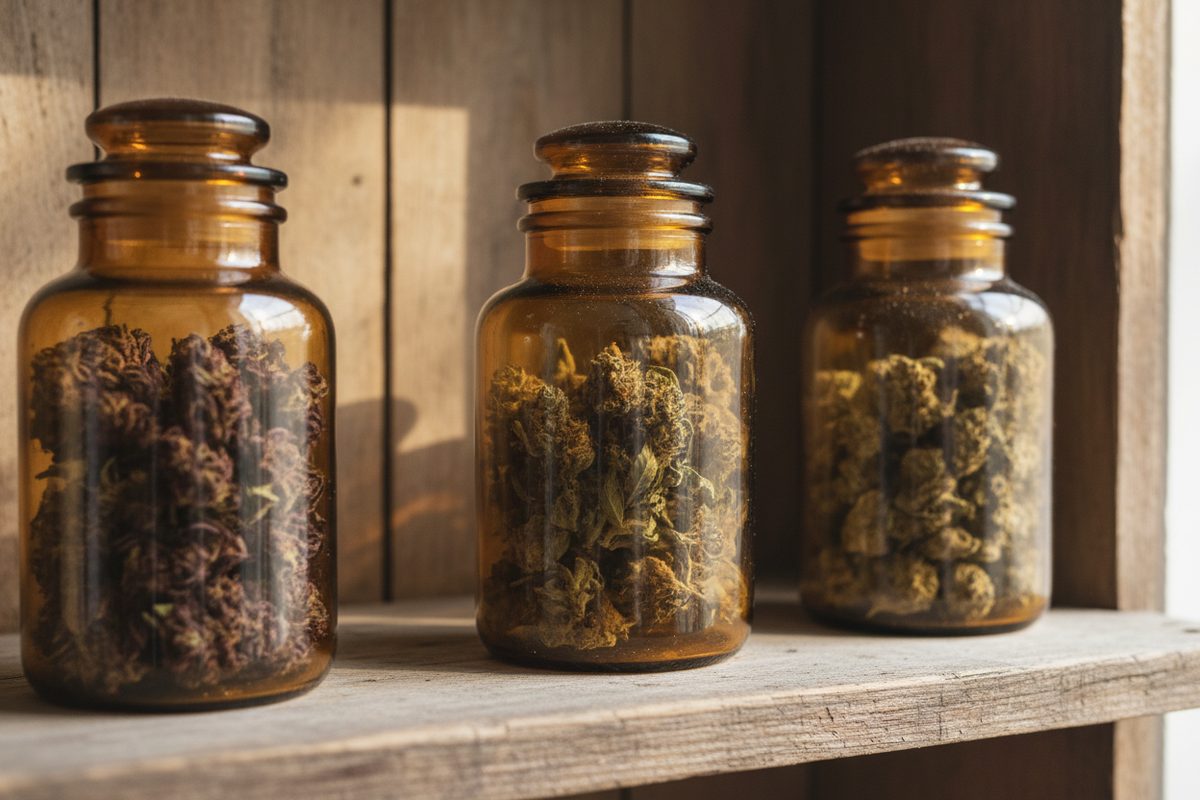
The cannabis plant contains over 100 unique cannabinoids and more than 200 aromatic compounds called terpenes. If that sounds overwhelming, don't worry. As a beginner, understanding just a handful of these compounds will give you a solid foundation for making informed choices.
Think of it this way: cannabinoids are what cannabis does to your body, and terpenes help shape how it does it. Together, they create the unique profile of every cannabis product you encounter.
THC (Tetrahydrocannabinol)
THC is the primary psychoactive compound in cannabis. It produces the "high" most people associate with cannabis by binding to CB1 receptors in the brain, much like your body's own endocannabinoid anandamide does, but it sticks around longer because your body doesn't break it down as quickly.

What THC Does
Beyond producing psychoactive effects, THC is the compound most associated with medicinal benefits. Research supports its role in:
- Pain relief — The 2025 OHSU meta-analysis found that oral THC-only products slightly reduced pain severity
- Appetite stimulation — FDA-approved for HIV-related appetite loss (as dronabinol)
- Nausea reduction — FDA-approved for chemotherapy-related nausea (as dronabinol and nabilone)
- Anxiety relief — At low doses (4 to 7.5 mg), THC has consistently shown anxiolytic (anti-anxiety) effects in controlled human studies
THC Risks and Considerations
THC is not without risks. The same compound that relieves anxiety at low doses can increase anxiety at higher doses — a phenomenon known as the biphasic effect. In one study, just 5 mg separated a calming dose from an anxiety-producing one.
Other considerations include:
- Impairment of short-term memory and motor coordination while under the effects
- High-potency THC products (over 10%) have been associated with higher rates of anxiety disorders, particularly in younger users
- Daily use of high-potency products may carry cardiovascular risks
- Approximately 29% of medical cannabis users met criteria for cannabis use disorder in a major 2025 JAMA review
CBD (Cannabidiol)
CBD does not produce a high. It interacts with the endocannabinoid system differently than THC and has been widely marketed for pain, anxiety, and sleep. However, it's important to be honest about what the research actually shows.
What the Research Supports
The strongest evidence for CBD is in epilepsy treatment. The FDA-approved medication Epidiolex (purified CBD) has demonstrated significant efficacy in treating Dravet syndrome and Lennox-Gastaut syndrome in children. This represents some of the most rigorous clinical evidence in all of cannabis medicine.
CBD may also play a supporting role in:
- Anxiety — Some studies suggest anxiolytic effects, though evidence is mixed
- Sleep — High-dose CBD (50+ mg) may have sedative properties, while low-dose CBD can actually increase alertness (another biphasic effect)
- Inflammation — Anti-inflammatory properties have been demonstrated in preclinical research
- Moderating THC — CBD may buffer some of THC's psychoactive effects, which is why 1:1 THC:CBD ratios are often recommended for beginners
The CBD-Only Pain Reality Check
A 2025 meta-analysis found that CBD-only products demonstrated almost no improvement in managing pain. This was described as surprising by the researchers themselves, since conventional wisdom had positioned CBD as promising precisely because it lacked psychoactive effects.
Oregon Health & Science University (OHSU), Annals of Internal Medicine, 2025
This finding challenges a lot of what you may have heard. The CBD market has grown into a multi-billion dollar industry, with products marketed for everything from chronic pain to general wellness. But when researchers looked specifically at pain outcomes, CBD on its own didn't deliver meaningful results.
This doesn't mean CBD is useless — it has a strong evidence base for specific conditions like epilepsy, and it may work differently when combined with other cannabinoids (see the entourage effect below). But if you're considering CBD primarily for pain, you should know the current state of the evidence.
Emerging Cannabinoids: CBN, CBG, CBC, and THCV
Beyond THC and CBD, researchers are investigating a growing list of "minor" cannabinoids. The research on these compounds is still in its early stages, so treat marketing claims with a healthy dose of skepticism. Here's what we know so far.
CBN (Cannabinol)
CBN is often marketed as "the sleep cannabinoid," and you'll find it in many sleep-focused cannabis products. It's mildly psychoactive and forms naturally as THC ages and oxidizes — so older cannabis tends to have higher CBN levels.
The honest take: research on CBN is limited. Early studies and patient reports suggest sedative properties, but we don't yet have the robust clinical trials needed to make strong claims. If you're considering CBN for sleep, it may work best in combination with THC and sleep-promoting terpenes like myrcene and linalool rather than on its own.
CBG (Cannabigerol)
CBG is sometimes called the "mother cannabinoid" because other cannabinoids are chemically derived from its acidic form (CBGA) as the plant matures. It's non-psychoactive and is being studied for potential anti-inflammatory and neuroprotective properties.
CBG products are becoming more widely available, but the research is still preclinical — meaning most studies have been conducted in labs or animal models, not in human trials. Promising, but not proven.
CBC (Cannabichromene)
CBC is one of the most abundant cannabinoids in the plant but one of the least studied. It's non-psychoactive and has shown anti-inflammatory and analgesic (pain-relieving) properties in preclinical research. CBC doesn't bind well to CB1 receptors, but it may interact with other receptors in the body, including TRPV1 and TRPA1, which are involved in pain perception.
THCV (Tetrahydrocannabivarin)
THCV is particularly interesting because it appears to have its own biphasic effect — at low doses, it may actually be anti-psychoactive, potentially reducing some of THC's effects. At higher doses, it becomes psychoactive. Early research has also explored THCV's potential for appetite suppression (the opposite of THC's well-known appetite stimulation) and blood sugar regulation, though this work is preliminary.
Terpenes: The Aromatic Compounds
Beyond cannabinoids, cannabis contains aromatic compounds called terpenes that contribute to each product's unique smell, flavor, and — potentially — its effects. Over 200 terpenes have been identified in cannabis, though only a handful appear in significant concentrations.
Terpenes aren't unique to cannabis. They're found throughout the plant kingdom: the citrus burst when you peel an orange (limonene), the calming scent of lavender (linalool), the refreshing aroma of pine trees (pinene). When you encounter these terpenes in cannabis, they bring similar aromatic and potentially therapeutic qualities.
Key Terpenes to Know
Myrcene
The most abundant terpene in many cannabis products. It has an earthy, herbal aroma and is also found in mangoes, lemongrass, and hops. Myrcene is associated with relaxation and sedation — products high in myrcene are often the ones described as producing a calming, "couch-lock" effect. Research suggests anti-inflammatory properties, particularly when applied topically.
Limonene
Bright citrus aroma, also found in lemon peels and orange rinds. Limonene is associated with mood elevation, stress relief, and energy. Animal studies have shown anxiolytic (anti-anxiety) effects. Products high in limonene tend to be described as uplifting or energizing.
Linalool
Floral, lavender-like aroma — it's actually the primary terpene in lavender itself. Linalool is associated with calming, anti-anxiety, and sleep-promoting effects.
A randomized clinical trial found that Silexan (a lavender essential oil rich in linalool) produced more anxiolytic effects than paroxetine (a common SSRI antidepressant) in adults with Generalized Anxiety Disorder.
Randomized clinical trial on Silexan vs. paroxetine for GAD
Beta-Caryophyllene
Spicy, peppery aroma, also found in black pepper and cloves. Beta-caryophyllene is unique among terpenes because it binds directly to CB2 receptors in the immune system, making it technically both a terpene and a cannabinoid. It's associated with anti-inflammatory and pain-relieving properties.
Here's a practical tip: black pepper is a common remedy for THC over-intoxication. If you ever feel too high, chewing or sniffing black peppercorns may help. This likely works because beta-caryophyllene interacts with the endocannabinoid system to reduce sensitivity to THC.
Alpha-Pinene
Fresh pine aroma, also found in pine needles and rosemary. Pinene is associated with mental clarity and alertness. It has been suggested as potentially useful for counteracting some of THC's cognitive effects, particularly short-term memory impairment.
Terpinolene
Fresh, herbal, slightly floral. Less common but found in well-known products derived from strains like Jack Herer. Associated with uplifting, energetic effects.
Quick Reference: Common Cannabis Terpenes
| Terpene | Aroma | Also Found In | Associated Effects |
|---|---|---|---|
| Myrcene | Earthy, herbal | Mangoes, lemongrass, hops | Relaxation, sedation, anti-inflammatory |
| Limonene | Citrus | Lemon peels, orange rinds | Mood elevation, stress relief, energy |
| Linalool | Floral, lavender | Lavender, birch bark | Calming, anti-anxiety, sleep-promoting |
| Beta-Caryophyllene | Spicy, peppery | Black pepper, cloves | Anti-inflammatory, pain relief (binds CB2) |
| Alpha-Pinene | Pine, fresh | Pine needles, rosemary | Mental clarity, alertness |
| Terpinolene | Herbal, floral | Nutmeg, tea tree | Uplifting, energetic |
The Entourage Effect
The entourage effect is a theory first proposed in 1998 by Raphael Mechoulam — often called the "father of cannabis research" — suggesting that cannabis compounds work better together than in isolation. In other words, a whole-plant extract containing THC, CBD, minor cannabinoids, and terpenes may produce different (and potentially better) therapeutic effects than any single isolated compound.
The research picture is evolving:
A comprehensive review published in <em>Pharmaceuticals</em> (2024) found exploratory evidence supporting therapeutic benefits of specific terpenes when combined with cannabinoids. A study published in <em>Nature</em> using animal models confirmed that terpenes can bind with cannabinoid receptors and boost THC's CB1 receptor activation, supporting the entourage effect at a molecular level.
MDPI Pharmaceuticals, 2024 — "The Entourage Effect in Cannabis Medicinal Products: A Comprehensive Review"
However, the picture isn't entirely clear. An earlier 2020 study in Frontiers in Pharmacology found that terpenes alone did not directly mediate activity at cannabinoid receptors, suggesting their benefits may come through other biological pathways rather than direct receptor binding.
Terpenes alone did not directly mediate activity at cannabinoid receptors, suggesting their benefits may come through other pathways.
Frontiers in Pharmacology, 2020 — "Terpenoids From Cannabis Do Not Mediate an Entourage Effect by Acting at Cannabinoid Receptors"
What does this mean practically? The entourage effect is plausible and supported by growing evidence, but the science is still filling in the details. For now, many researchers and clinicians recommend full-spectrum or whole-plant products over isolated compounds when possible, on the theory that the complete chemical profile of the plant may offer advantages over any single ingredient.
Why "Indica vs. Sativa" Is Outdated
If you've done any reading about cannabis, you've probably encountered the idea that "indica" strains are relaxing and "sativa" strains are energizing. This classification was useful shorthand for decades, but modern science tells us it's largely misleading.
The terms indica and sativa originally described the physical appearance of the plant — indica plants tend to be short and bushy, while sativa plants tend to be tall and narrow. But after decades of cross-breeding, the genetic lines have become so blurred that almost every commercially available product is technically a hybrid.
More importantly, the indica/sativa label tells you very little about the chemical profile of the product — and it's the chemical profile that actually determines how it will affect you. Two products both labeled "indica" can have wildly different cannabinoid and terpene compositions, and therefore wildly different effects.
What Actually Matters: Cannabinoid and Terpene Profiles
Instead of relying on indica/sativa labels, look at:
- THC and CBD percentages — These tell you the potency and the likely balance between psychoactive and non-psychoactive effects
- THC:CBD ratio — A 1:1 ratio will feel very different from a 20:1 ratio
- Terpene profile — This is where the "indica-like" or "sativa-like" experience actually comes from
Where to Go From Here
Now that you understand the key compounds in cannabis, you're ready to explore how they reach your body. Different methods of consumption affect how quickly and intensely you feel these cannabinoids and terpenes, and choosing the right method is one of the most important decisions for a beginner.
You'll also want to understand dosing fundamentals — because with THC especially, the difference between a therapeutic dose and an uncomfortable one can be surprisingly small.