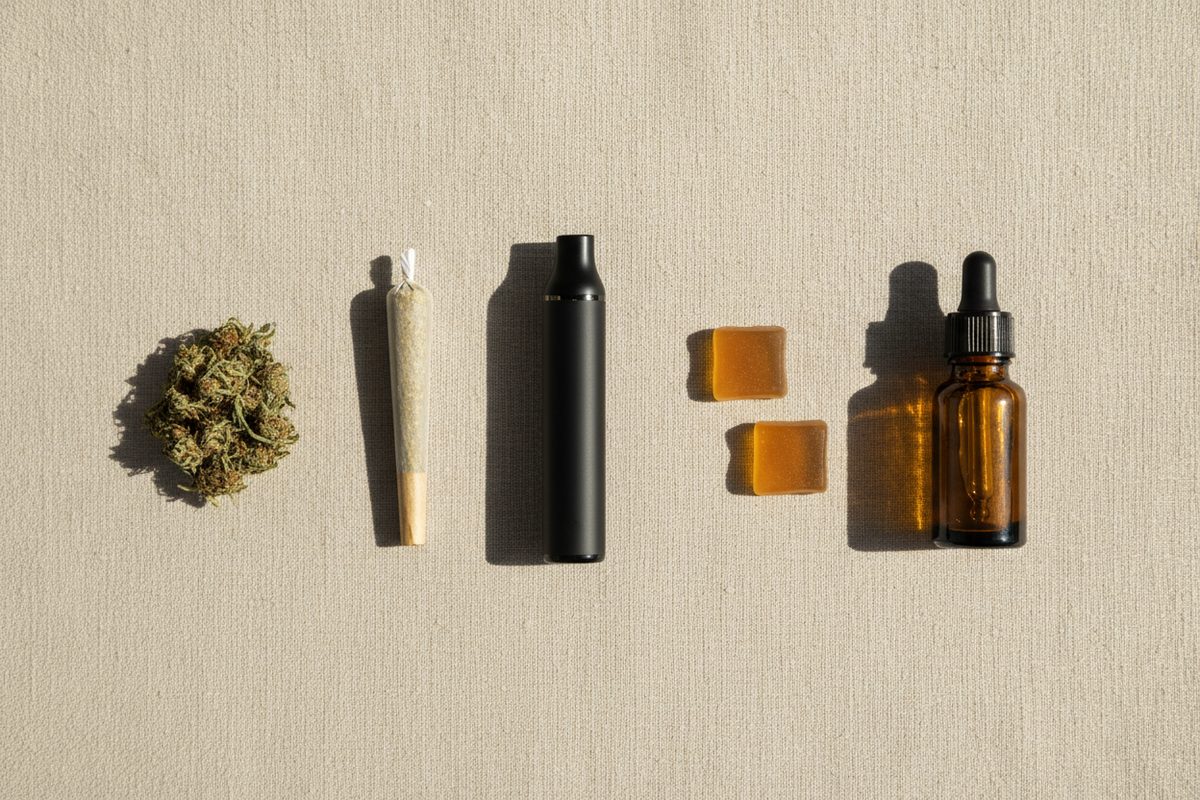
For someone who has never used cannabis, choosing a consumption method is one of the first and most important decisions. Each method has a different onset time, duration, level of dosing control, and set of health considerations. There is no single "best" method — the right choice depends on your goals, your comfort level, and what condition you're addressing.
Understanding the differences also helps explain why two people can use the same product and have very different experiences. A 10 mg THC edible and a 10 mg THC tincture deliver their cannabinoids through different pathways, and your body processes them differently as a result.
Quick Reference: Consumption Method Comparison
Here's an at-a-glance comparison. We'll break down each method in detail below.
| Method | Onset | Duration | Dose Control | Psychoactive | Lung Risk |
|---|---|---|---|---|---|
| Smoking | 1–10 min | 1–3 hrs | Moderate | Yes | Yes |
| Vaporizing | 1–10 min | 1–3 hrs | Moderate | Yes | Reduced |
| Edibles | 30 min–2 hrs | 4–8+ hrs | High (if standardized) | Yes (often more intense) | None |
| Tinctures (sublingual) | 15–45 min | 4–6 hrs | Very High | Yes | None |
| Topicals | 5–30 min | 2–4 hrs | Moderate | No (localized only) | None |
Inhalation (Smoking and Vaporizing)
How It Works
When you inhale cannabis, cannabinoids pass directly from the lungs into the bloodstream, bypassing the digestive system and liver entirely. This direct route is why inhalation produces the fastest onset of any consumption method.
Onset, Duration, and Bioavailability
- Onset: 1 to 10 minutes
- Duration: 1 to 3 hours
- Bioavailability: Approximately 10 to 35% for smoking. Vaporizing may achieve higher bioavailability (some estimates suggest 50 to 80%), though more conservative research puts inhaled bioavailability at around 31% on average.
Smoking vs. Vaporizing
There's an important distinction between these two inhalation methods. Smoking involves combustion — burning plant material at high temperatures, which produces tar, carbon monoxide, and other irritants along with the cannabinoids. While cannabis smoke has not been linked to lung cancer at the same rate as tobacco, it can cause bronchial irritation and respiratory symptoms over time.
Vaporizing heats cannabis below the combustion point (typically 315–440°F / 157–227°C), releasing cannabinoids and terpenes as vapor without the byproducts of burning. This reduces many of the respiratory concerns associated with smoking.
A note of caution: the 2019 "vaping crisis" in the United States highlighted that black-market vape cartridges can contain dangerous additives, including vitamin E acetate. This is a strong reason to only purchase vaporizer products from licensed dispensaries, where products undergo lab testing.
Pros
- Fastest onset of any method — you feel the effects quickly
- Easy dose titration: take one puff, wait 10 to 15 minutes, and assess before taking more
- Effects are relatively short-lived, which is an advantage if you're nervous about your first experience
- Full terpene expression (you taste and smell the product's profile)
Cons
- Smoking produces respiratory irritants
- Not discreet (odor)
- Shorter duration means more frequent dosing for sustained relief
- Difficult to measure precise milligram doses
Edibles (Gummies, Chocolates, Capsules, Beverages)
How It Works
When you eat or drink cannabis, it's processed through the digestive system and liver. This is where things get interesting — and where most beginner mistakes happen.
During what's called first-pass metabolism, the liver converts Delta-9-THC into 11-hydroxy-THC, a metabolite that is more potent than the original compound and crosses the blood-brain barrier more easily. This is why edibles often feel stronger and more body-focused than inhaled cannabis, even at the same milligram dose.
During first-pass metabolism, the liver converts Delta-9-THC into 11-hydroxy-THC, a metabolite that is more potent than the original compound and crosses the blood-brain barrier more easily. This is why edibles often feel stronger and more body-focused than inhaled cannabis.
Cannabis pharmacology: first-pass metabolism and 11-hydroxy-THC
Onset, Duration, and Bioavailability
- Onset: 30 minutes to 2 hours (sometimes longer)
- Duration: 4 to 8 hours, sometimes longer depending on dose and individual metabolism
- Bioavailability: Approximately 4 to 20%. Much lower than inhalation because a significant portion of cannabinoids are lost during digestion. However, the conversion to 11-hydroxy-THC compensates for this with increased potency.
The Number One Beginner Mistake
The delayed onset of edibles is the single most common source of accidental overconsumption for beginners. The pattern is almost always the same:
- You take a dose
- You feel nothing after an hour
- You think it didn't work and take more
- Both doses hit at once
This is not a pleasant experience. The effects of edible overconsumption can last 8 to 12 hours, and there's no way to speed up the process once the cannabinoids are in your system. Patience is not optional with edibles — it's essential.
Pros
- No lung exposure whatsoever
- Precise dosing is possible with standardized products (gummies labeled at 5 mg or 10 mg per piece)
- Longer duration is beneficial for conditions requiring sustained relief, like chronic pain or insomnia
- Discreet — no odor, looks like ordinary food
Cons
- Delayed onset makes overconsumption easy
- Effects can be intense and long-lasting, which can be uncomfortable if you've taken too much
- Individual variation in metabolism means the same dose can affect two people very differently
- Food in your stomach, your metabolic rate, and even your body composition all affect how edibles hit
Tinctures and Oils (Sublingual)
How It Works
Tinctures are liquid cannabis extracts that come with a measured dropper. The key technique is sublingual absorption: you place the drops under your tongue and hold them there for 60 to 90 seconds. The cannabinoids are absorbed directly into the bloodstream through the blood vessels beneath the tongue, bypassing the digestive system.
If you swallow a tincture instead of holding it sublingually, it behaves more like an edible — slower onset, liver metabolism, and the conversion to 11-hydroxy-THC.
Onset, Duration, and Bioavailability
- Onset: 15 to 45 minutes when used sublingually
- Duration: 4 to 6 hours
- Bioavailability: Approximately 40 to 50% for sublingual use — significantly higher than edibles
Pros
- Excellent dose control — measured with a dropper, often down to 1 mg increments
- Faster than edibles, more controlled than inhalation
- No lung exposure
- Discreet and odorless
- Easy to adjust dose gradually (add one drop at a time)
Cons
- Taste can be earthy or unpleasant for some people (many products now come flavored)
- Requires proper technique — you need to actually hold the liquid under your tongue, not just swallow it
- Slightly less convenient than popping a gummy
Topicals (Creams, Balms, Salves)
How It Works
Topicals are applied directly to the skin. Cannabinoids interact with local CB2 receptors in the skin and underlying tissue without entering the bloodstream in significant amounts. This means you get localized effects without any psychoactive experience — you will not feel high.
An important distinction: standard topicals (creams, balms, salves) stay local. Transdermal formulations are specifically designed to penetrate deeper and deliver cannabinoids into the bloodstream, which means they can produce systemic effects. Check the product labeling carefully.
Onset, Duration, and Bioavailability
- Onset: Minutes to about 30 minutes for localized effects
- Duration: Variable, typically 2 to 4 hours
- Bioavailability: Very low systemically. Effects are localized to the application area.
Pros
- No psychoactive effects — you will not get high
- Targeted relief for localized pain, inflammation, or skin conditions
- Safe to use without worrying about impairment
- Can be used alongside any other consumption method
- No concerns about drug testing (standard topicals don't enter the bloodstream in meaningful amounts)
Cons
- Will not help with systemic conditions like anxiety, insomnia, or widespread pain
- Limited research on effectiveness
- Effects are confined to the application area
- Can be messy or greasy depending on the formulation
How to Choose Your First Method
With all these options, here's a practical framework for deciding where to start:
If your top priority is safety and zero impairment: Start with topicals. You'll experience localized relief with no psychoactive effects.
If you want precise, controlled dosing for a health condition: Start with tinctures. The sublingual method gives you milligram-level control and a moderate onset time.
If you want fast feedback to learn how cannabis affects you: Try vaporizing dry herb. The rapid onset lets you take one puff, assess, and decide whether to continue.
If you need long-lasting relief (4+ hours): Consider edibles, but only after you've read the Dosing Fundamentals page and committed to starting at 2.5 mg or less.
Regardless of which method you choose, the principle is the same: start low, go slow. You can always take more, but you can never take less.
Where to Go From Here
Now that you understand how cannabis enters your body, the next critical step is understanding how much to use. The Dosing Fundamentals page covers starting doses for each method, the biphasic effect (why more isn't always better), microdosing, THC:CBD ratios, and keeping a cannabis journal to track what works for you.
If you haven't already, it's also worth reading about cannabinoids and terpenes to understand what compounds you're working with, and how to read lab results so you can evaluate products before you buy them.